


It may not be the most appealing topic in the world, but did you know that the colour of your poo can give you valuable information about your health? Observing the colour of your stool has been a fundamental medical tool used since ancient times to diagnose different diseases. And details about the timing, consistency and colour give us a lot of information about our digestive system.
Stools take on a brownish hue under normal circumstances. This phenomenon is the result of biochemical transformations inherent to the intestinal digestive process, as well as pigments contained in certain substances eliminated along with the excretions.
Approximately 75% of the stool composition is water and the remaining 25% is a combination of different substances and wastes (carbohydrates, fibre, fat, proteins, bacteria, bile, bilirubin...).
The brown hue is caused primarily by the presence of bile, a fluid produced by the liver that facilitates the breakdown of fats, and bilirubin, which results from the breakdown of erythrocytes.
If the colour of your stools differs from the usual brown colour it could be an indication of a disturbance in the digestive system. Let's see what the different colours can mean
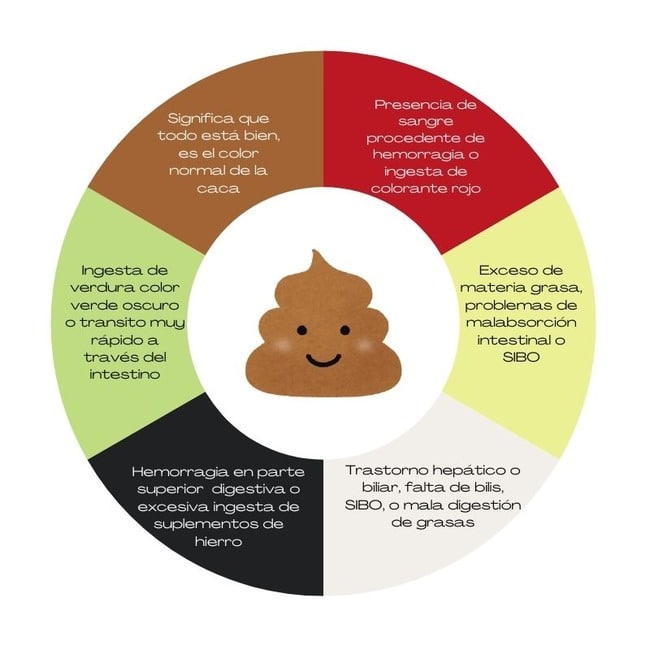
The black colour of your stools may be due to the consumption of certain medications such as iron supplements or foods such as liquorice or squid ink.
However, black poo can also be a sign of serious digestive problems such as bleeding in the upper digestive tract, as blood becomes this colour after being digested in the intestine. For example, ulcers, tumours and other lesions of the intestinal epithelium may bleed. This blood mixes with bile and other digestive fluids to form black, tarry-looking faeces called “melenas”.
Yellow stools can have a variety of reasons. Problems in the liver, gallbladder and pancreas can alter the production and use of bile during digestion. Variations in bile levels can cause changes in stool colour.
Coeliac disease can also cause your stools to turn yellow. The disease damages the wall of the small intestine, compromising its ability to absorb nutrients such as fats. If you suspect you may have coeliac disease, you can be tested for it. coeliac disease test at home to find out for sure.
Stress has a number of physical impacts on the body, including speeding up the digestive process. This can lead to the body not being able to absorb all the nutrients from food properly, which in turn can lead to diarrhoea or yellow stools.
If your poo is this colour, it may be because you eat a lot of dark green vegetables (spinach, broccoli, kale, etc.). If this is the case, you don't need to worry, but there are also other causes that can produce this colour change:

Red-coloured stools can have different causes. One cause is ingestion of foods containing red food colouring, such as fruit punch, candy or jelly. This can temporarily stain the stool without any health problems. On the other hand, the presence of fresh blood from a haemorrhage in the lower part of the system can also cause the stool to become red.
The digestive tract (large intestine, rectum or anus) may also change the colour of the stool to a reddish hue. It is important to note that when the bleeding occurs in this area, the blood is not digested in the intestine, so it does not turn a dark colour as it does when the blood passes through the entire digestive tract.
Pale or clay-coloured faeces may be due to a decrease in bile production (e.g. patients with liver cirrhosis or hepatitis) or a blockage of the bile ducts (caused by “stones” or gallstones). Bile is one of the substances that gives poo its brown colour and therefore less bile will make the stool lighter in colour.
In addition, bile contributes to the digestion of lipids; if its production or secretion decreases, the fats in the diet will not be digested, cannot be absorbed and will be eliminated in the faeces. The presence of fatty matter in the faeces will cause them to have a foamy appearance (steatorrhoea).
Other pathologies that can cause faeces to have a pale colour and a frothy appearance are:
If you eat a fibre-rich diet, exercise regularly, try to reduce your stress and drink water and stay hydrated, you will promote proper bowel function and your stools should be brown in colour, soft in texture and easy to pass.
If you experience a change in the colour and/or appearance of your stools on a one-off basis, there is nothing to be alarmed about. However, it is advisable to see your GP if this change persists over time.
Wang, T. Y. et al. New insights into the molecular mechanism of intestinal fatty acid absorption. European journal of clinical investigation 43(11), 1203-1223, doi: 10.1111/eci.12161 (2013).
DeGeorge LM, Nable JV. Gastrointestinal bleeding. Walls RM, ed. Rosen's Emergency Medicine: Concepts and Clinical Practice. 10th ed. Philadelphia, PA: Elsevier; chap 26 (2023).